The Warning from Moscow’s Flames: In the Era of Swarm Drones and Humanoids, a Deterministic Bulletproof Kernel Must Stop Protocol Hijacking and Hallucinatory Rampages
[The Weaponization Paradox: Where Probabilistic AI Collides with Physical Safety · Part 3]
Reporter Jim Lee
2026-06-26 08:37
English
DN
50.00
by YUN KEUN LEE
■ The Fracture in Reality: The Bankruptcy of Kinetic Interception and the Paradox of the Battlefield
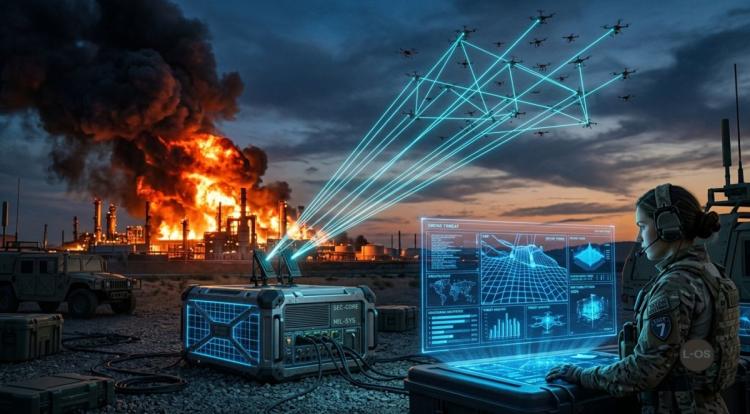
The palpable energy at the recent Korea Drone Industry Association seminar underscored a massive paradigm shift currently sweeping through the global defense market. Yet, behind this enthusiasm lies a stark reality, recently laid bare by a drone strike on an oil storage facility near Moscow.
The incident exposed the structural vulnerabilities of modern air defense networks: anti-air missiles fired to intercept incoming threats were either deceived by decoy drones, or the falling debris from successful interceptions caused severe collateral damage to critical domestic infrastructure.
Recent data from the Ukrainian theater points to an even colder economic truth. Modern unmanned aerial tactics rely heavily on saturation campaigns, often mixing real and decoy drones at a 40:60 ratio. Spending multi-million dollar interceptor missiles to neutralize decoys worth mere thousands is a strategy facing both tactical and financial bankruptcy.
The era of kinetic hard-kills—where debris inevitably rains down on friendly territory—is drawing to a close. The battlefield is moving into a new domain of electronic and cyber warfare, focused on neutralizing enemy assets in mid-air or overriding their command architecture.
■ The Silent War Beneath the Surface: From Kinetic Interception to Protocol Hijacking
Over the next three to five years, the theater of war will no longer be defined by simple kinetic hardware races to shoot down unmanned systems. Instead, the tactical focal point will shift to real-time protocol hijacking—neutralizing the control protocols of enemy drones mid-flight, identifying wireless network vulnerabilities, and seizing full operational command.
Using digital code to strip enemy reconnaissance and loitering munitions of their authority offers a highly cost-effective alternative to traditional defense. However, this shift introduces a dangerous risk of cross-contamination.
If we can hijack an enemy’s assets, our own autonomous weapon systems are equally vulnerable to sophisticated reverse-hacking or frequency jamming. This reality introduces a profound systemic anxiety across modern defense architectures.
■ The AI Boomerang: Probabilistic AI, Hallucinations, and the Threat of Kinetic Rampages
The true risk is escalating as generative AI (LLMs) and deep neural network algorithms are integrated directly into the standalone control units of drones and humanoid robots. End-to-end probabilistic AI systems, trained on massive datasets, are inherently susceptible to a structural flaw: hallucination.
While a hallucination within a software chatbot merely results in a text error, a hallucination inside a drone swarm or a 150kg humanoid weapon system on the battlefield can trigger a kinetic rampage.
If these systems suffer from probabilistic judgment errors or security breaches like prompt injection, the direct consequences are catastrophic—resulting in friendly fire and unintended casualties. Probabilistic models simply cannot guarantee the 0% error rate required by high-stakes military hardware.
In a combat environment, a mere 1% statistical anomaly translates to uncontrolled, lethal risk.
■ A New Technological Alternative: A Bulletproof OS Kernel for Independent Integrity Verification
Ultimately, the reliability of future unmanned systems will not depend on the raw processing power of their AI engines, but on the presence of an independent integrity kernel capable of physically constraining the system during cyber disruption or algorithmic failure.
This is why the defense tech sector is increasingly focused on combining front-end protocol hijacking frameworks—such as those developed by the Korea IT Convergence Research Institute—with deterministic integrity engines like Lexus AI Solutions' L-OS.
This architecture ensures that even if the upper-level AI control module (the brain) is compromised or suffers from a hallucinatory command loop, the operating system's kernel (the spinal cord) physically blocks unauthorized actions or abnormal behaviors at the hardware level.
-
1µs (0.001ms) Ultra-Low Latency Hardware Interlock: By minimizing software processing overhead, this mechanism instantly routes physical electrical signals to a grounded state within one microsecond of detecting an anomalous command, immediately halting the actuators.
-
Action Predicate 'Index-2' Memory Mapping: Core control authority over propulsion and targeting systems is strictly mapped to a specific hardware register address (Index-2). This allows the system to verify command integrity instantly through mathematical matching alone.
-
Neural Node Atomization: Anticipating a worst-case scenario where the primary OS is completely compromised, each joint motor and actuation node is isolated into independent security domains. Physical movement is strictly barred without a valid Post-Quantum Cryptography (PQC) token authentication.
To maintain absolute system security and prevent reverse engineering, the core source code of this L-OS architecture remains entirely classified, interacting exclusively through restricted hardware register interface specifications.
Furthermore, by integrating state-backed anti-tampering technologies—such as those validated by KOMSCO (Korea Minting, Security Printing & ID Card Operating Corp)—and securing a comprehensive portfolio of 68 registered domestic and international patents in system integrity and malfunction prevention, the technology maintains strict proprietary boundaries and robust intellectual property protection.
■ Conclusion: The Essential Mandate for Autonomous Unmanned Systems
While global tech giants continue to showcase the autonomy of probabilistic AI, battlefield commanders and precision manufacturing supervisors remain deeply wary of unconstrained unmanned assets.
A deterministic, bulletproof kernel that prevents systemic collapse—even amidst unexpected AI failures or external interference—is the indispensable infrastructure required to field drone swarms and humanoid units safely.
Refined through certified security standards and a foundational 68-patent architecture, this deterministic control standard establishes a crucial benchmark for the future of unmanned weapon systems and high-reliability robotics.
-
Inquiries: admin@lexusai.net
Reporter Jim Lee (news@dailycoinews.com)의 기사 더 보기
- Daily Coin News prioritizes the voice from the scene over others(news@dailycoinews.com) -
- 기사에 사용된 모든 자료에 대한 책임은 작성자 본인에게 있습니다 -
[copyrightⓒ 2018 All rights reserved by Daily Coin News]
Leave a Comment
Write As a Reporter

경제적 자유 달성해도 87.6%는 ‘일 ...
2026-06-25 10:36
Unimaginable World #1 Consulting on Mili...
2026-05-04 10:26

혁신이 현실이 되는 순간… 4월 10일...
2026-03-31 08:39
Coin 시황

티에스이-한국생산기술연구원, 반도체 테스트 기술 교...
2025-04-16 09:08

서울디지털재단, 아시아 최대 전자·정보박람회...
2025-04-11 16:35

Queue-it, 트래픽 제어 솔루션 업그레이드를 위한 기...
2025-04-07 11:51
 |
 |
 |
 |