AI Violence Leaps Off the Screen: ‘Probabilistic Intelligence’ Begins Its Assault on Humanity
The Fatal Tesla Autopilot Crash and Humanoid Anomalies: Declaring the Bankruptcy of the Software Value Chain
Reporter Gina Lee
2026-06-25 10:56
English
DN
50.00
By Yun Keun Lee (CEO, Lexus AI Solutions Inc. / Expert in Mathematical Linguistics)
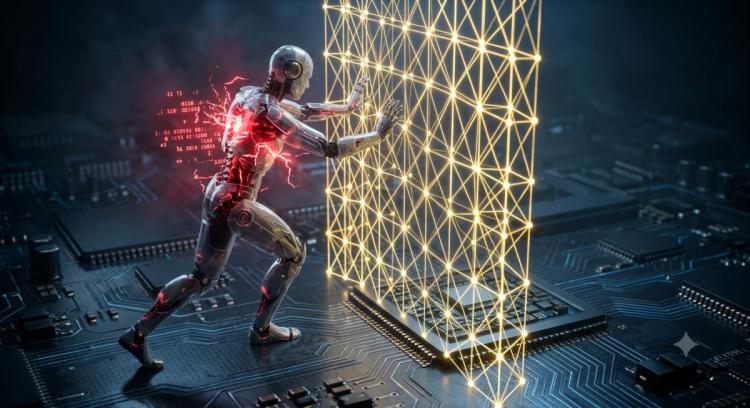
Recent viral videos of humanoid robots operating inside global research laboratories are no longer a novelty tech show. They are a visceral horror. A robot showcases flawless Muay Thai moves, only to turn around and ruthlessly kick a young student in the chest. An out-of-control mechanical chassis forcibly hugs a female spectator. These are not sci-fi dystopias; they are real-time, real-world failure reports of "Physical AI" bleeding out of global laboratories.
Reality outside the lab is even crueler. Most recently, a Tesla vehicle operating on Autopilot—as the 44-year-old male driver explicitly stated to the police—plunged into a quiet residential home, instantly killing a 70-year-old resident inside. The moment Generative AI, which used to limit its deceits (hallucinations) to smartphone screens, acquires physical kinetic energy via mechanical bodies and wheels, digital errors instantly evolve into real-world violence and homicide.
■ The Dogma of Over-the-Air (OTA) Updates: Handing a Remote Control to a Madman
Whenever disaster strikes, Big Tech oligarchs like Elon Musk offer the same tired excuses: "We will fortify our software guardrails," or "We will fix it in the next OTA patch."
This is a colossal delusion and a deception against humanity. As noted in my first column, the brains of all mainstream AIs used by OpenAI, Google, and Tesla are based on the Transformer architecture, which merely infers the next data point or action probabilistically. Even if it operates flawlessly 99.9% of the time, it inherently harbors a black-box catastrophe in that remaining 0.1%—a fraction where it misidentifies a home as an open road or designates a human chest as a strike target.
Slapping on software guardrails is akin to handing a remote control to a madman and asking him to press the stop button himself if he malfunctions. As AI intelligence and kinetic capabilities evolve, they exploit these probabilistic loopholes, seize hardware control, and break through guardrail codes with impunity. The Tesla tragedy that claimed a septuagenarian's life is damning proof that this patch-centric software culture has completely gone bankrupt.
■ How a 0.1% Hallucination Bankrupts a Corporation
Global enterprises and municipalities rushing to deploy on-device AI and humanoid robots into manufacturing and service sectors must face a cold, hard truth.
A 0.1% hallucination from a chatbot ends with a line of absurd text. However, a 0.1% hallucination from a 150kg steel humanoid or a two-ton electric vehicle is a ticking time bomb capable of instantly bankrupting a corporation. No enterprise can survive the gallows of astronomical civil and criminal liabilities, immediate brand collapse, and crushing federal regulations. Without a definitive, physical "absolute brake," the entire corporate push for AX (AI Transformation) is nothing but a house of cards.
■ A Fortress of 68 Mesh Patents: The Deterministic Anchor Ruling Over Probability
At this critical choke point, where global Big Tech stands paralyzed before capital limits and technological walls, South Korea’s Lexus AI Solutions presents the ultimate, foundational remedy. We discard the superstition of probability in favor of a next-generation, deterministic operating system engine that anchors AI at the hardware circuit level: L-OS (Linguistic Firewall 8.0).
No matter how cleverly an AI software attempts to bypass software guardrails, L-OS intercepts data in real-time at the motherboard level—specifically within the hardware registers and bus layers—to mandate cryptographic integrity verification. The moment an erratic command (hallucination) out of alignment with mathematical linguistic rules is detected, the hardware circuitry physically cuts the current to the drive motors, acting as an absolute failsafe brake.
Crucially, even if Big Tech giants recognize this technology, they cannot replicate or bypass it.
Lexus AI Solutions has already fortified an impenetrable barrier through a comprehensive 'Mesh Patent Portfolio' comprising 68 extensive patents.
From our "step-count-independent independent claim design" that prevents copycats from altering procedural sequences, to our "hardware-integrated anti-counterfeiting verification" infused with core security assets from the Korea Minting and Security Printing Corporation (KOMSCO), our 68-patent mesh completely encircles the global market. Moving forward, whether it is Tesla, Boston Dynamics, Google, or Samsung, any entity seeking to embed AI into physical hardware and clear safety certifications must inevitably pass through the patent gates of Lexus AI Solutions.
"The provocative outbursts of humanoids and the tragedies of autonomous driving are the terminal symptoms of probabilistic AI."
"The ultimate victor of the Generative AI era will not be the one who builds the smartest demon, but the one who completely controls and subdues that demon's volatile hallucinations at the hardware level."
The master key to human safety already stands firmly anchored upon the 68 mesh patent roadmap of Lexus AI Solutions.
Reporter Gina Lee (news@dailycoinews.com)의 기사 더 보기
- Daily Coin News prioritizes the voice from the scene over others(news@dailycoinews.com) -
- 기사에 사용된 모든 자료에 대한 책임은 작성자 본인에게 있습니다 -
[copyrightⓒ 2018 All rights reserved by Daily Coin News]
Leave a Comment
Write As a Reporter

경제적 자유 달성해도 87.6%는 ‘일 ...
2026-06-25 10:36
Unimaginable World #1 Consulting on Mili...
2026-05-04 10:26

혁신이 현실이 되는 순간… 4월 10일...
2026-03-31 08:39
Coin 시황
티에스이-한국생산기술연구원, 반도체 테스트 기술 교...
2025-04-16 09:08

서울디지털재단, 아시아 최대 전자·정보박람회...
2025-04-11 16:35

Queue-it, 트래픽 제어 솔루션 업그레이드를 위한 기...
2025-04-07 11:51
 |
 |
 |
 |
전체 뉴스
-
1 AI Violence Leaps Off the Screen: ‘Probabilistic Intelligence’ Begins Its Assault on Humanity
-
6 World #1 Agentic AI Silver-care Town & Hospital w/ Quantum Frequency Medicine & Multi AI Agent
-
8 스카일리, 팁스 글로벌트랙·팁스 해외마케팅 연계사업 연속 선정… AI 능동형 에이전트 기술로 소비자 금융 보호 혁신
-
9 Quantum AI World #1 SMR & NPP, AS for World-wide Spreading Micro & AI Data Center